Appearance
Step 0: Plan Your Project
Understanding OR Through a Restaurant Analogy
Restaurant Analogy
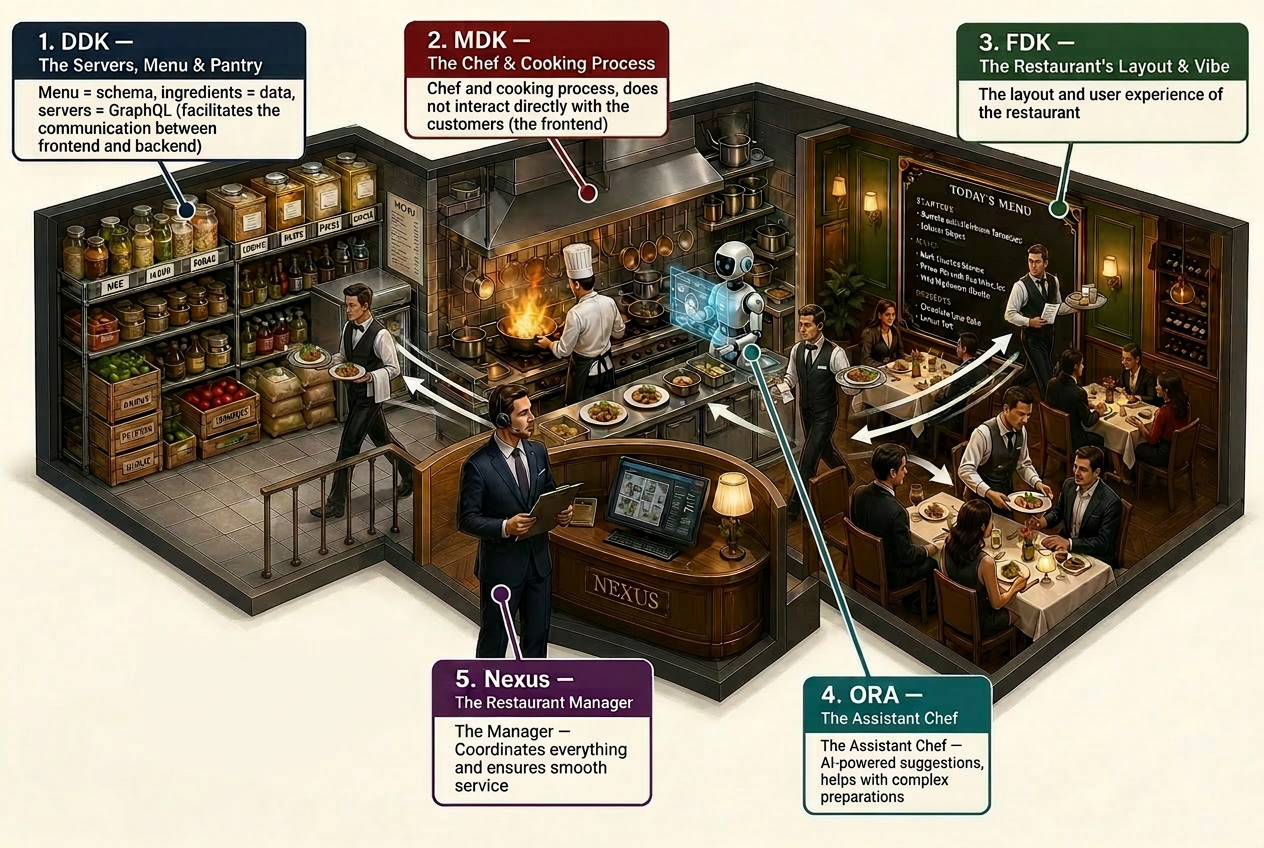
Think of building an application in Optimal Reality like running a restaurant. Each Development Kit (DK) plays a specific role in bringing everything together:
| DK | Restaurant Role | What It Does |
|---|---|---|
| DDK (Data Development Kit) | The Servers, Menu & Pantry | The servers take orders and deliver dishes to customers. The menu defines what's available to order (your schema). The pantry stores all the ingredients (your actual data). Together, they manage what data exists, how it's organized, and how it's served to those who need it. |
| MDK (Modelling Development Kit) | The Chef & Cooking Process | Takes ingredients from the pantry and transforms them into finished dishes. This is where AI models, simulations, and workflows process your raw data into valuable insights and predictions. |
| FDK (Frontend Development Kit) | The Restaurant Layout & Ambiance | Creates the entire dining experience — the interior design, the atmosphere, the table arrangements, and how customers interact with the space. This is the overall user experience of your application. |
| Nexus | The Restaurant Manager | Keeps everything running smoothly, monitors the health of operations, manages staff deployment, and ensures all services are working together. |
| ORA | The Assistant Chef | An AI helper that assists with planning menus, suggesting recipes, and helping execute complex preparations. |
Just like a restaurant needs all these roles working together to serve customers, OR needs these development kits working in harmony to deliver powerful applications. You can start by setting up your "kitchen" (DDK), then learn to "cook" with your data (MDK), and finally create the "restaurant" for your users (FDK). Or, you can start by creating the restaurant and user experience (your FDK), then working backwards to add the data in using your MDK and DDK.
Planning Questions
Before you start building in Optimal Reality, take time to plan your project. Answering these key questions upfront will help you build the right solution more efficiently.
What You'll Learn
- Define the problem your application will solve
- Identify what data you need to track
- Determine if you need AI/predictions or just data display
- Understand who will use your application and what they need to do
- Get AI-assisted planning guidance
What problem are you solving?
Write a clear statement of the problem your application addresses. This helps you stay focused on what matters.
Examples:
- "Emergency department wait times are unpredictable, leading to patient dissatisfaction and staff stress"
- "We can't efficiently schedule vessels at our port, causing delays and lost revenue"
- "Mining operations lack real-time visibility into equipment location and status"
AI Prompt
Try asking an AI assistant:
I'm building an operations application for [INDUSTRY].
Help me clearly define the core problem I'm trying to solve related to [BRIEF DESCRIPTION].
Give me 3-5 specific problem statements I could use.
What data do you need to track?
List all the entities (things) and their properties that your application needs to monitor or manage.
Think about:
- Physical entities: Equipment, vehicles, people, locations, facilities
- Events: Appointments, arrivals, departures, incidents, transactions
- Measurements: Sensor readings, performance metrics, status indicators
- Configurations: Settings, thresholds, schedules, rules
Example for Hospital ED:
- Patients (name, arrival time, triage level, chief complaint)
- Staff (name, role, shift times, current assignment)
- Rooms (room number, type, equipment, availability status)
- Treatments (type, duration, required resources)
AI Prompt
Try asking an AI assistant:
I'm building an application for [YOUR PROBLEM STATEMENT].
What data entities and their key properties should I track?
Organize them into main entities and supporting entities.
Ready to Build?
Once you've answered these questions, you're ready to create your project!